Just Bought a House with a Tankless Water Heater? Your First 30-Day Checklist
You just closed on a house in Orange County and found a tankless water heater mounted in the garage or on an exterior wall. Maybe the home inspector mentioned it. Maybe the listing touted "endless hot water" as a selling point.
Either way, you now own a piece of equipment that costs $2,000-$4,500 to replace, has specific maintenance requirements, and may or may not have been properly cared for by the previous owner. What you do in the next 30 days will determine whether this unit lasts another decade or becomes a surprise expense within the year.
Step 1: Identify the Unit — Brand, Model, and Age
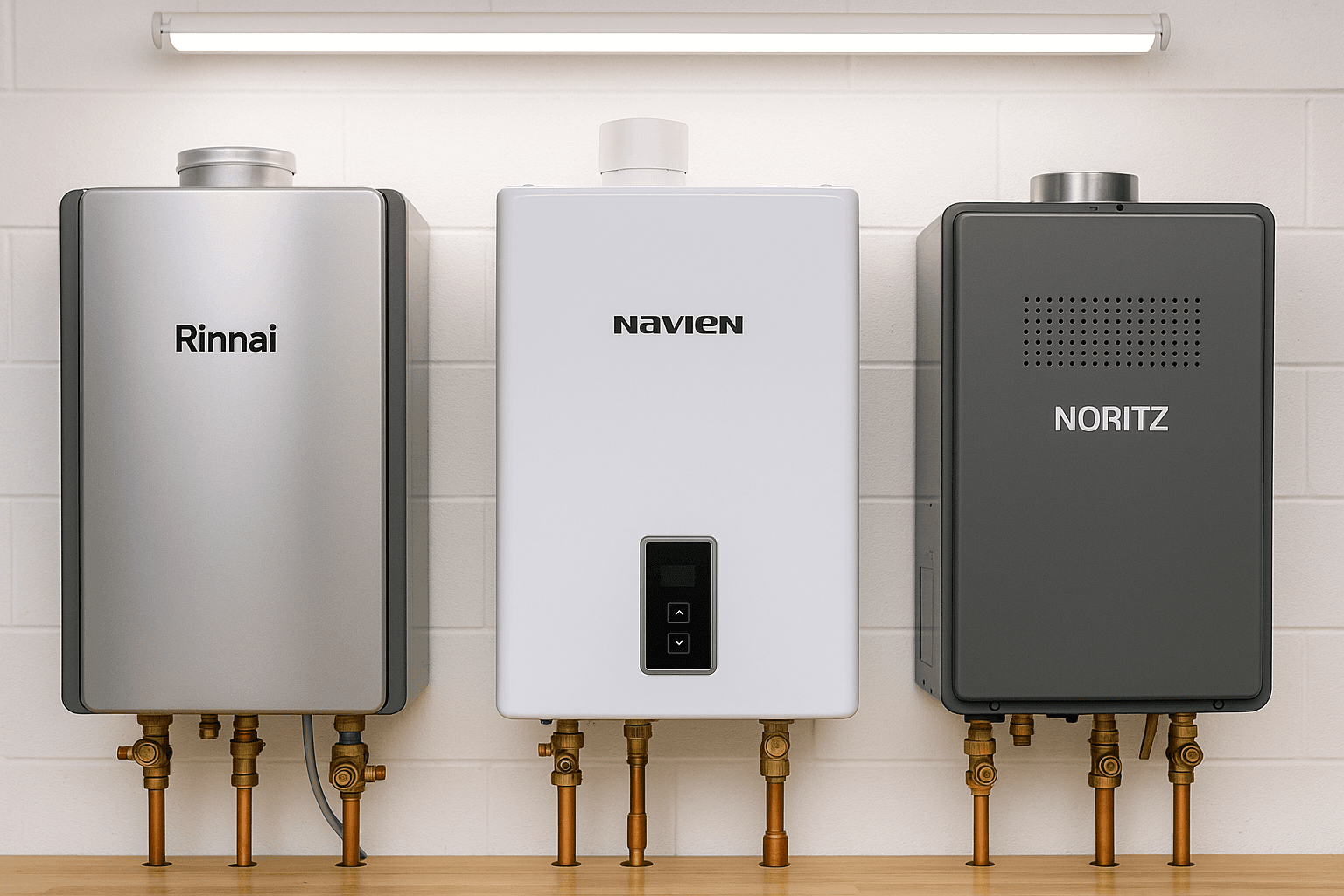
Walk up to the unit and find the manufacturer's label — typically on the front panel or side. Write down the brand (Rinnai, Navien, Noritz, Rheem, and Bosch are the most common in Orange County — our brand comparison guide covers the maintenance differences between them), model number (tells you BTU rating and capacity), and serial number (determines age and warranty status).
How to Determine the Age
Most manufacturers encode the manufacturing date in the serial number:
- Rinnai — First two digits represent the year. A serial starting with "19" was made in 2019. You can verify your model on the Rinnai product registration page.
- Navien — Look for a four-digit YYMM date code within the serial number. Check the Navien product support page for model details.
- Noritz — First two characters indicate the manufacturing year.
- Rheem — Recent units use the first four digits for week and year (WWYY).
If you can't decode it, search the model number on the manufacturer's website. Knowing the age tells you how much lifespan remains — most tankless units last 15-20 years with proper maintenance — and whether the unit is still under warranty.
Check Warranty Status
Most manufacturers offer a 10-15 year heat exchanger warranty, but nearly all require documented annual maintenance to keep it valid. If the previous owner never flushed the unit, the manufacturer can deny a future warranty claim. Getting a professional flush on record during your first month of ownership establishes your own documentation trail regardless of what the previous owner did or didn't do.
Step 2: Investigate the Service History
This is where most new homeowners hit a wall. Here's where to look:
- Service sticker on the unit. Many technicians leave a dated sticker after servicing. If you find one, call that company for the full history.
- Home inspection report. Your inspector may have noted the unit's condition, error codes, or visible scale.
- Seller disclosures. Check for any mention of water heater maintenance or repairs.
- Appliance documents. Sellers sometimes leave manuals and receipts. Look for anything related to plumbing service.
- The real estate agent. Your agent or the seller's agent may be able to track down records.
If you can't find any evidence of previous maintenance, treat the unit as if it has never been flushed. In our experience, that's the accurate assumption more often than not. Many homeowners don't realize tankless water heaters require regular flushing. We regularly service units that are 5-7 years old and have never been flushed once.
Step 3: Why Your First Flush Is Urgent with No Service History
When you buy a car with an unknown oil change history, the first thing you do is change the oil. The same logic applies here.
A tankless water heater running on Orange County's hard water (250-400 ppm) for an unknown period could have anywhere from a thin film of scale to a dangerously thick mineral crust on the heat exchanger. You have no way of knowing without flushing it.
The Risks of Waiting
- Hidden performance loss. The unit might appear to work fine. Scale degradation is gradual — the previous owner may have been living with lukewarm showers and high gas bills without connecting the cause.
- Warranty exposure. Every month without documented maintenance is a month the manufacturer can point to in a warranty dispute.
- Compounding damage. If the unit already has 18 months of scale and you wait another 6, you're at 24 months — a threshold where permanent heat exchanger damage becomes a real possibility.
- Surprise failures. The worst time to discover a maintenance problem is during a January cold snap when every plumber in OC is booked.
What a First Flush Reveals
The volume and color of the scale that comes out during a flush tells us how long it's been since the last service — if there ever was one. We also inspect the inlet filter, check for error code history, and assess the overall condition. This first flush gives you a clean baseline to build your maintenance schedule from.
Step 4: Check Your Water Hardness
Orange County water is hard across the board, but the exact level at your address determines your maintenance frequency.
How to check: Your water district publishes an annual Consumer Confidence Report with hardness data (search your city name plus "water quality report"). For an immediate reading, pick up a water hardness test strip kit at any hardware store for under $10.
What Your Hardness Level Means
| Water Hardness | Flush Interval (No Softener) | Flush Interval (With Softener) |
|---|---|---|
| 250-300 ppm | Every 9-12 months | Every 12 months |
| 300-350 ppm | Every 6-9 months | Every 9-12 months |
| 350-400+ ppm | Every 6 months | Every 9 months |
South OC cities — Laguna Niguel, Lake Forest, Mission Viejo, San Juan Capistrano — consistently fall in the 300-400+ ppm range. North and Central OC cities like Anaheim, Fullerton, Irvine, and Costa Mesa typically fall in the 250-320 ppm range.
For a deeper dive by city, read our guide on hard water and tankless water heaters in Orange County.
Step 5: Set Up a Maintenance Schedule
Now that you know the brand, age, service history (or lack thereof), and your water hardness, set a recurring schedule:
- Tankless water heater flush — Every 6-12 months depending on water hardness
- Inlet filter check — Included with every professional flush, but worth checking yourself between services if you notice reduced flow
- Error code check — Glance at the display panel monthly. If you see any codes, look them up in our error code guide before problems escalate
Set a recurring calendar reminder aligned to your flush interval. Treat it like an oil change — a scheduled expense that prevents an unscheduled emergency. Some homeowners pair it with their spring or fall HVAC service to keep it on the radar.
Step 6: Red Flags from the Previous Owner
During your first month, watch for signs of neglect that increase the urgency of your first flush.
No Isolation Valves
Look at the pipes connecting to the unit. You should see shut-off valves on both water lines plus service ports (small brass valves with caps) for pump connection. If these are missing, flushing was never convenient — and likely never happened. Installing them is a one-time cost that makes all future flushing faster.
Visible Corrosion or Staining
Green corrosion on copper fittings, white mineral deposits around connections, or rust staining on the wall beneath the unit can indicate leaks, condensation issues, or long-term neglect.
Error Codes on the Display
If the unit shows an error code, don't ignore it. Some are informational (like Rinnai's LC flush reminder), but others indicate active problems. Check our error code guide to identify what you're seeing.
Unusual Sounds
Turn on a hot water tap and stand near the unit. Normal sounds are a soft ignition click and fan hum. Rumbling, popping, cracking, or whistling almost always means scale buildup. Read more about the warning signs that your unit needs flushing.
DIY Modifications
Non-standard plumbing, aftermarket parts, or modifications that don't match manufacturer specs suggest the previous owner may have created issues that aren't immediately visible.
Your 30-Day Action Plan
Week 1: Identify brand, model, serial number, and age. Check for a service sticker and isolation valves. Note any error codes or unusual sounds.
Week 2: Search for service history — seller disclosures, appliance documents, home inspection report. Test your water hardness.
Week 3: Schedule your first professional flush. See our flush cost guide for Orange County to understand what the service includes and what it costs. If the unit has no documented service history, this is non-negotiable.
Week 4: After the flush, set your recurring maintenance calendar based on your water hardness level. Store the flush documentation with your home records for warranty purposes.
Start Your Maintenance on the Right Foot
You made a significant investment in this home. The tankless water heater is one of the most valuable mechanical systems in the house, and it's one of the easiest to protect with proactive maintenance.
Tankless Flush Pro provides flat-rate $349 flushing for all brands throughout Orange County. Every service includes commercial-grade descaling, inlet filter cleaning, full system inspection, and warranty-compliant documentation. No trip fees. No hidden charges.
Schedule your first flush as a new homeowner today and start your ownership with a clean baseline and a clear maintenance plan.