Rinnai LC Code, Navien E003, Noritz Error 16: What Your Tankless Water Heater Is Telling You
Your tankless water heater just flashed an error code on its display. Maybe the hot water still works. Maybe it doesn't. Either way, you're staring at a combination of letters and numbers that means nothing to you and everything to the unit.
Error codes are your tankless water heater's way of communicating a specific problem. Some are minor maintenance reminders. Others are urgent warnings that the unit is protecting itself from damage. The difference between the two determines whether you need a quick flush or a $1,500 repair.
Here's what the most common error codes from Rinnai, Navien, and Noritz actually mean, what's happening inside your unit when they appear, and what to do about each one — especially if you live in Orange County where hard water makes these codes show up far more frequently.
What Tankless Error Codes Actually Mean (and Why Yours Won't Go Away)
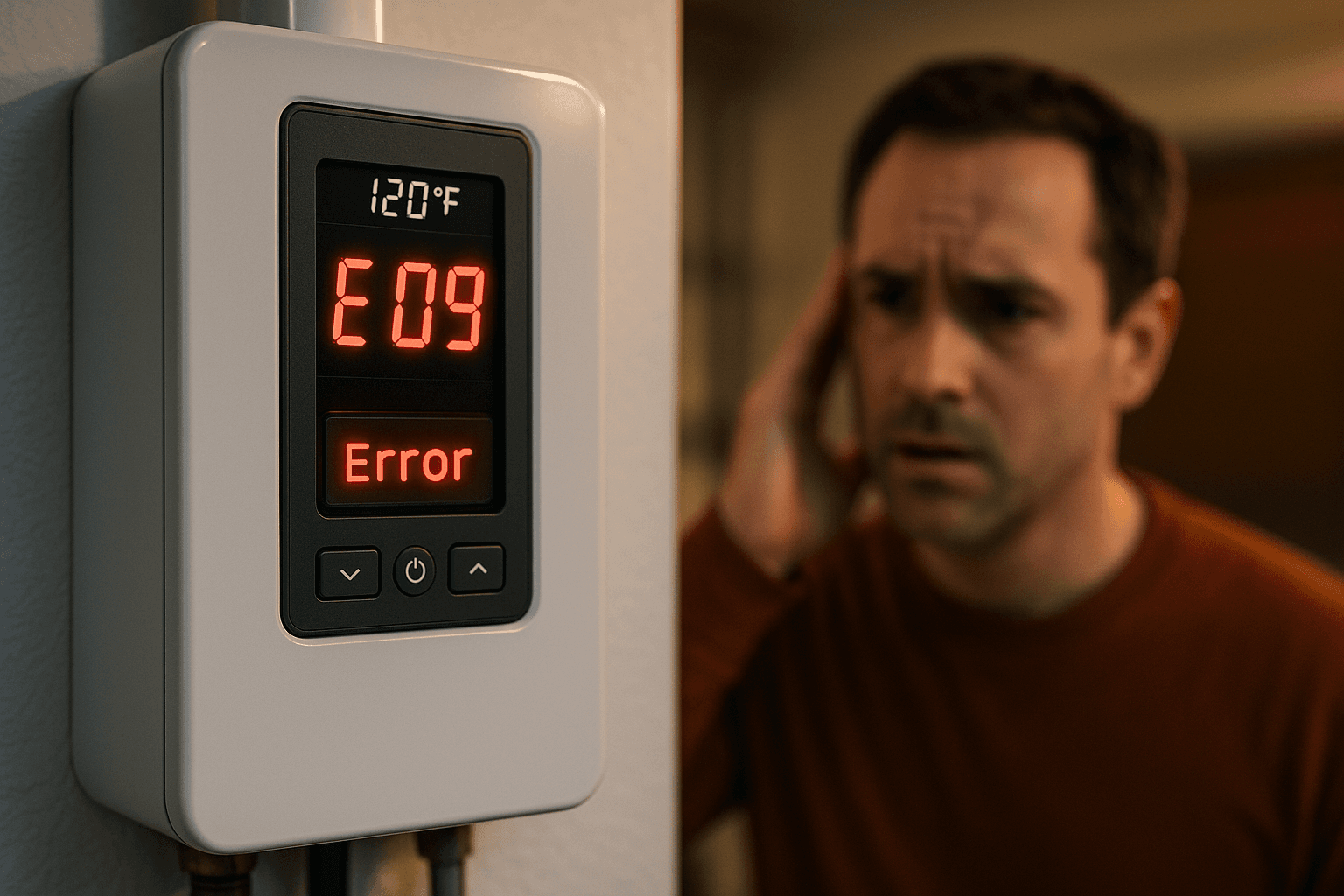
Every tankless water heater has a built-in diagnostic system that monitors sensors throughout the unit. When a sensor reading falls outside its expected range, the control board generates a specific error code and displays it on the front panel, remote controller, or both.
Some codes are informational — the unit is telling you it needs attention but continues operating. Others are lockout codes — the unit shuts down to prevent damage and won't restart until the underlying issue is resolved.
The critical thing to understand is that error codes are symptoms, not diagnoses. The same code can have multiple root causes. An ignition failure code might mean a dirty flame rod, a gas supply problem, a venting blockage, or a control board failure. The code tells you what the unit detected. A technician determines why.
In Orange County, however, there's a strong pattern. The vast majority of error codes we see on service calls trace back to one root cause: mineral scale buildup from hard water. When you're running 250-400 ppm water through a compact heat exchanger thousands of times per year, scale affects nearly every sensor and component in the system.
Rinnai LC / LC0-LC9 Code: The Scale Warning
Rinnai is the only major tankless brand that gives you an advance warning about scale buildup, and they do it through the LC code system. You can find more details on Rinnai's support page.
How the LC Countdown Works
Rinnai units track cumulative burn time — the total number of hours the burner has fired since the last reset. When the unit reaches a predetermined threshold (typically around 500 hours of burn time), it begins displaying the LC code.
The code starts at LC0 and counts upward to LC9, with each increment representing additional burn time beyond the initial threshold. Here's what the progression looks like:
- LC0: Initial maintenance alert. The unit has reached its service interval. Flushing is recommended.
- LC1-LC4: The unit is overdue for flushing. Scale is accumulating faster than the system can compensate.
- LC5-LC7: The unit is significantly overdue. Efficiency is declining, and component stress is increasing.
- LC8-LC9: The unit is at risk of component damage. Extended operation at this stage can lead to heat exchanger failure, flow sensor damage, or thermal fuse activation. If you're noticing signs your tankless water heater needs flushing, don't wait until the code climbs higher.
Throughout the entire LC sequence, the unit continues to operate. It will heat water. It will not lock out. This is both helpful and dangerous — helpful because you still have hot water, dangerous because it gives homeowners a false sense that the problem isn't urgent.
The Temporary Reset: Press On/Off Five Times
Rinnai allows you to temporarily clear the LC code by pressing the On/Off button on the unit's control panel five times in succession. The code disappears from the display, and the unit resets its countdown.
This is a temporary fix that buys you time. It does not remove any scale. It does not reset the actual condition of the heat exchanger. It simply clears the display.
How much time it buys you depends on how much scale is already present. On a unit that was flushed six months ago and is just hitting its first LC0, a reset might buy you several weeks before the code reappears. On a unit that hasn't been flushed in two years, the code may return in one to three days because the burn time threshold is reached almost immediately.
If you reset the LC code and it returns within a week, your unit needs professional flushing now — not next month.
Navien E001, E003, E012: When Scale Hits the Flame Rod
Navien units do not have a gradual countdown system like Rinnai. Instead, they go straight to error codes when scale causes a measurable problem — refer to Navien's support resources for full code documentation. This means by the time you see the code, the issue has already progressed beyond the "maintenance reminder" stage.
E001: Overheating
The E001 code indicates that the heat exchanger outlet temperature has exceeded its safety limit. This usually means one of two things:
- Scale is insulating the heat exchanger walls, causing the burner to work harder to transfer heat through the mineral layer. The metal surface overheats even though the water temperature isn't reaching the set point.
- Flow is restricted by scale deposits, reducing the volume of water passing through the exchanger. Less water means the water that does pass through absorbs too much heat.
E001 is a lockout code. The unit shuts down and will not restart until the condition clears.
E003: Ignition Failure
The E003 code means the unit attempted to ignite the burner and failed. In Orange County, the most common cause is scale buildup on the flame rod sensor.
The flame rod is a small metal probe that extends into the burner chamber. When the burner fires, the flame rod detects the presence of a flame through electrical conductivity. If scale coats the flame rod, it can't detect the flame, and the control board assumes ignition failed.
The unit typically attempts ignition three times before locking out with E003. You can sometimes reset the unit and get it to fire again, but if the flame rod is scaled, the code will return — often within hours or days.
E012: Flame Loss
E012 indicates that the unit successfully ignited but lost the flame during operation. The causes overlap with E003 — a scaled flame rod that intermittently loses its ability to detect the flame, or a gas supply fluctuation. In hard water areas, the flame rod is the first suspect.
The Flame Rod Problem in Hard Water Areas
Navien flame rods are particularly sensitive to mineral contamination. The sensor relies on a microamp-level electrical signal that passes through the flame. Even a thin layer of mineral deposit on the rod can reduce this signal below the detection threshold.
In Orange County's hard water, flame rod issues account for a significant percentage of Navien service calls. A professional flush combined with flame rod cleaning resolves the issue in most cases. If the rod is corroded beneath the scale, replacement is straightforward and inexpensive — the part itself typically costs $15-$30, with the labor being the primary expense.
Noritz Error Codes 11 and 16: Ignition Failure and Overheating
Noritz uses a numeric error code system without the advance warning that Rinnai provides — see Noritz's support page for their full error code reference. When a Noritz unit displays an error, the problem is already affecting operation.
Error Code 11: No Ignition
Noritz Error 11 is the equivalent of Navien's E003 — the unit attempted to ignite and failed. The same causes apply: scaled flame rod, dirty ignition electrode, gas supply issue, or venting problem.
What makes Noritz Error 11 particularly frustrating for homeowners is the lack of prior warning. There's no LC-style countdown, no gradual performance degradation that you'd notice. The unit works perfectly until the moment it doesn't. One morning you turn on the shower and get cold water and a flashing "11" on the display.
Error Code 16: Overheating (Abnormally High Water Temperature)
Error 16 indicates that the outgoing water temperature has exceeded the unit's safety limit. This is a direct parallel to Navien's E001 and is almost always caused by:
- Scale insulation on the heat exchanger — the burner overheats trying to push heat through mineral deposits
- Reduced water flow from scale restriction — less water volume means each unit of water absorbs more heat
Error 16 is a safety lockout. The unit will not restart until it cools down and the condition is addressed.
Error Code 29: Condensate Drain Blockage
While less common, Error 29 on condensing Noritz units indicates a blocked condensate drain, which can be caused by mineral deposits from hard water. The acidic condensate carries dissolved minerals that can accumulate in the drain line over time.
No Advance Warning: Why Noritz Units Need Proactive Maintenance
Without a built-in scale reminder, Noritz owners in Orange County need to be especially proactive about scheduling flushes. You won't get a helpful countdown telling you it's time. The unit will run normally until scale reaches the point of causing a measurable sensor anomaly, and at that point you're already dealing with a lockout code and no hot water.
For Noritz units in Orange County, we recommend setting your own reminder for every six to nine months rather than waiting for the unit to tell you something is wrong.
The Temporary Reset That Buys You Time (and Why You Should Still Call)
Most error codes can be temporarily cleared by power cycling the unit — turning it off, waiting 30 seconds, and turning it back on. Some codes clear on their own once the triggering condition passes (like an overheating code after the unit cools down).
Here's what a reset does and doesn't accomplish:
What a Reset Does
- Clears the error display
- Restarts the unit's diagnostic cycle
- May allow the unit to operate normally for a period of time
- Buys you time to schedule professional service
What a Reset Does Not Do
- Remove any scale from the heat exchanger
- Clean the flame rod or ignition electrode
- Fix a restricted flow path
- Prevent the code from returning
- Address the root cause of the error
Think of resetting an error code like resetting your check engine light. The light goes off, but the problem is still there. The light will come back. And every mile you drive with the underlying problem makes the eventual repair more expensive.
What a Professional Flush Actually Fixes vs. What It Doesn't
A professional tankless water heater flush is the correct response to most scale-related error codes. But it's important to understand what flushing can and cannot do.
What Flushing Fixes
- Removes mineral scale from the heat exchanger walls, restoring proper heat transfer and water flow
- Clears scale from sensors including flow sensors and temperature sensors
- Restores efficiency that was lost to insulating scale deposits — if scale has been driving up your gas bill, flushing typically brings costs back to normal
- Resolves overheating codes caused by restricted flow or insulated heat exchanger walls — and resolves most cases where your tankless isn't producing enough hot water
- Resets the LC countdown on Rinnai units (when done properly through the service menu, not just the On/Off button)
What Flushing Cannot Fix
- A cracked or perforated heat exchanger — if scale caused the metal to overheat and crack, the heat exchanger needs replacement
- A failed electronic component — control boards, gas valves, and wiring damaged by overheating require replacement
- Permanent flame rod corrosion — if the rod is pitted or corroded beneath the scale, it needs to be replaced (though this is a minor repair)
- Venting problems — error codes caused by improper venting, birds' nests, or disconnected vent pipes require separate diagnosis and repair
A professional technician can determine during the flush whether the error code is scale-related (resolvable with flushing) or indicates component damage that requires additional repair.
Orange County Hard Water: Why These Codes Appear 2-3x More Often Here
If you moved to Orange County from an area with softer water, you may have never dealt with tankless error codes before. There's a reason for that.
At 250-400 ppm, Orange County's water deposits calcium inside your heat exchanger at roughly two to three times the rate of an area with average water hardness (100-150 ppm). That means:
- Rinnai LC codes appear in 4-6 months instead of the 10-12 months the manufacturer's timer anticipates
- Navien flame rod codes occur 2-3x more frequently because the flame rod scales faster
- Noritz overheating and ignition codes surface in the first year instead of year two or three
Manufacturer maintenance intervals are based on national average water conditions. Orange County is not average. The 12-month flushing interval printed in your owner's manual is a minimum for moderate water conditions. In Orange County, every 6-9 months is the appropriate interval for units without a water softener.
The Compounding Effect
Scale doesn't accumulate linearly. The first layer of scale creates a rough surface that catches more minerals, which creates a rougher surface, which catches even more minerals. The rate of buildup accelerates over time. A unit that was fine at month six may be throwing error codes by month nine — and by month twelve, the scale may be partially hardened into a form that's difficult to remove even with commercial-grade descaling solution.
This is why we see more severe error codes and more component damage in Orange County than in areas with moderate water hardness. It's not just that scale builds up faster — it's that the window between "needs maintenance" and "needs repair" is shorter.
Don't Wait for an Error Code to Tell You
The best time to flush your tankless water heater is before it throws a code. Once you're staring at an error on the display, scale has already reached the point of affecting operation. In most cases, a professional flush will resolve the code and restore normal function. But every code represents unnecessary wear on components that have a finite lifespan.
Tankless Flush Pro provides flat-rate $349 tankless water heater flushing throughout Orange County. Every service includes commercial-grade descaling, flame rod and sensor cleaning, inlet filter service, full system inspection, and warranty-compliant documentation. If your unit is currently displaying an error code, we can diagnose whether flushing will resolve it or whether additional repair is needed — all included in the service visit.
Schedule your flush today before that error code turns into a repair bill.